
Using delegates to Resolve Dependency Issues
Chromium Repo Dependency Checks
The Chromium repository has strict restrictions on which modules are able to depend on the top level //ui, //chrome, or //content directories.
Directly from the //chromeos README:
- “This directory contains low-level support for Chrome running on ChromeOS.”
- “//chromeos does not contain any user-facing UI code, and hence it has "-ui" in its DEPS. The contents of //chromeos should also not depend on //chrome or //content.”
These limitations are enforced using "-chrome" in the DEPS file and apply to the
//chromeos, //ash/
When these rules are violated (by including a file from //chrome/
Running Python 3 presubmit upload checks ...
** Presubmit ERRORS: 1 **
You added one or more #includes that violate checkdeps rules.
  ash/webui/file_with_violation.cc
      Illegal include: "chrome/browser/utils.h"
    Because of "-chrome" from ash/webui's include_rules.

Presubmit checks took 5.4s to calculate.
There were Python 3 presubmit errors.
The diagram below gives a rough visualization of the separation of components in ChromeOS.
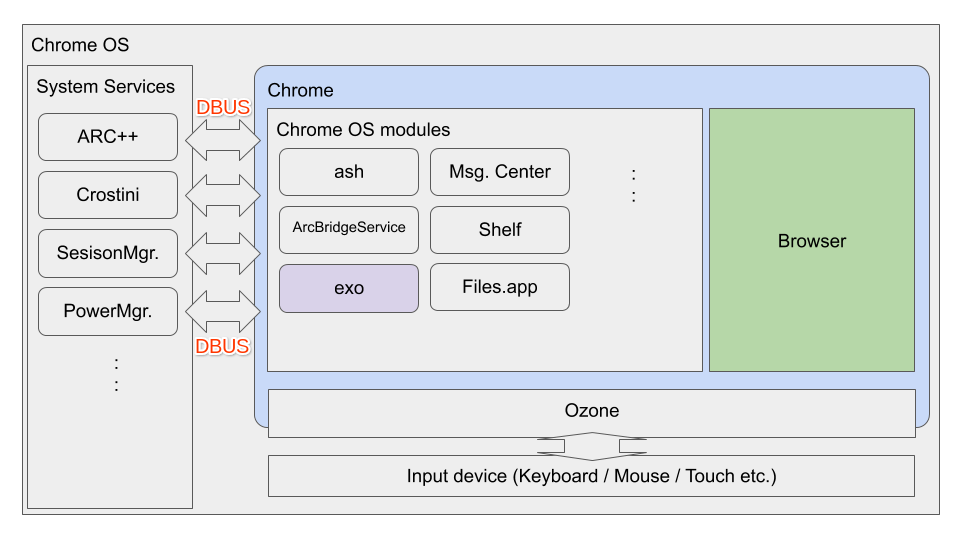 ChromeOS
architecture pre-LaCrOs
ChromeOS
architecture pre-LaCrOs
Delegate pattern to use Chrome from Ash
There will be numerous occasions where services in //ash/
To avoid repo dependency violations, in these situations we can utilize the
delegate pattern to get the data/
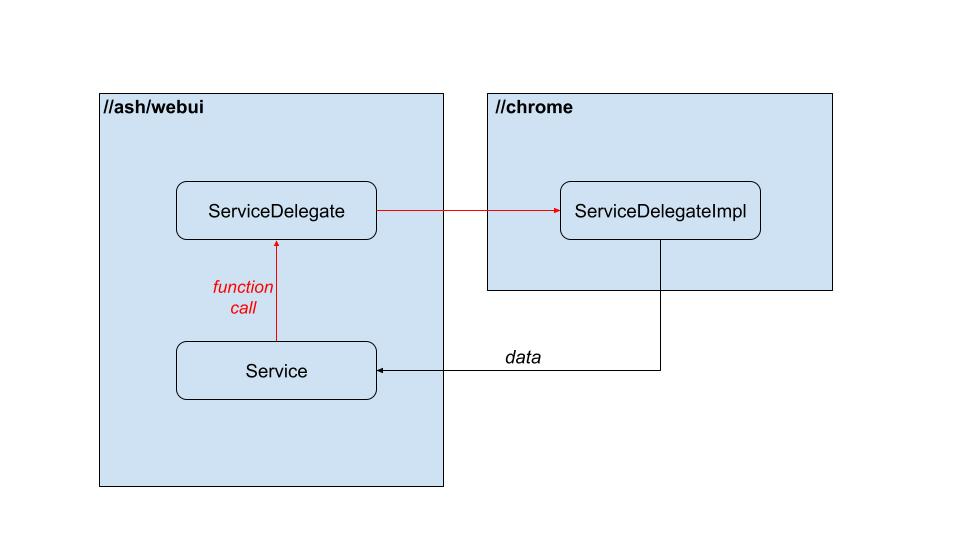 Sample
delegate pattern diagram
Sample
delegate pattern diagram
Creating a delegate
The below steps will use the existing
Scan App
implementation in //ash/
Define the functions in the header
Here the functions are defined which will be invoked by our //ash/
class ServiceDelegate {
 public:
  virtual ~ServiceDelegate() = default;

  virtual std::string GetStringFromChromeBrowser() = 0;
};
Scan app example
Create the implementation class
Since functions in //chrome can’t be called from //ash/
.h file
class ChromeServiceDelegate : public ServiceDelegate {
 public:
  ChromeServiceDelegate() override;

  std::string GetStringFromChromeBrowser() override;
};
Scan app example
.cc file
ChromeServiceDelegate::ChromeServiceDelegate() = default;

std::string ChromeServiceDelegate::GetStringFromChromeBrowser() {
  return chrome::ChromeBrowserFunction();
}
Scan app example
Pass the delegate implementation to the service
Probably the most difficult part in the process, the service in //ash/
Invoke the delegate function from the service
Once the delegate impl is passed to the service and stored as a private local variable, any function defined in the delegate header can now be invoked without worry of dependency conflicts.
.h file
class Service {
 private:
  std::string UseStringFromChrome();

  // Provides browser functionality from //chrome to the Service UI.
  std::unique_ptr<ServiceDelegate> service_delegate_;
};
Scan app example
.cc file
std::string Service::GetStringFromChromeBrowser() {
  service_delegate_->GetStringFromChromeBrowser();
}
Scan app example
Example CL
- crrev.com/
c/ 3290952