
Goals For The Origin Info Bubble
Introduction
This is the Origin Info Bubble (OIB):
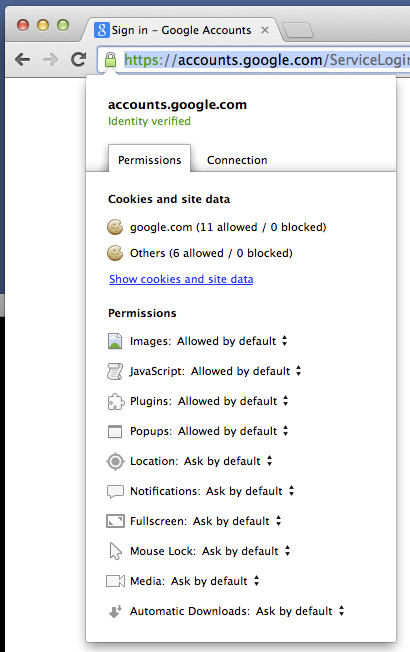
As you can see, it has a lot of stuff in it, with 2 tabs to hold 2 (arguably 3: site data, permissions, and connection state) broad categories of information and controls about what the origin is and what it can do.
We are pretty sure the OIB does not show all and only the information and controls that users need to understand and control an origin.
I believe the purpose of the OIB is to allow users to understand and control the origin. It was previously called the Page Info Bubble (PIB), but in this document I’ll use the more accurate name.
Since the OIB is the primary UI surface for control of an origin’s power, it enables the increased appification of the web platform. It is thus very important that we make it readily understandable and usable. See also https://code.google.com/p/chromium/issues/detail?id=421248.
Possible Goals
One can imagine the OIB serving a variety of purposes, including at least display or control of:
Information about the permissions/capability grants/special powers an origin
has

Information about the transport security state of the origin

    Authenticated + confidential; partially authenticated + confidential;
    unauthenticated or broken authentication or not confidential

    If authenticated: the certificate chain

        Or a control to launch the certificate viewer or other
        developer/operator debugging information

    If authenticated: extra authentication information

        Certificate Transparency status

        Key pinning information

        Controls to set user-defined authentication policy:

            Accept this certificate

            Pin to the key(s) in this certificate chain

            …

The origin’s name

Historical context for the user’s past interaction with the origin

    # times visited in some period

    downloads

    bookmarks

    when or how often the origin has invoked powerful grants/APIs

    …

Data the browser is storing locally for the origin

    cookies

    LocalStorage

    …

    Summary (storage quota, et c.)

Processes the browser is running locally for the origin

    Service Workers

    Geofences

    Total/average/peak battery cost of this origin

    …

Which extensions (if any) can access the origin

Others? Surely I’m forgetting something.
Obviously there’s no way we can really show/afford control of all that information. That is especially true on small screens, but even on a large screen it would be a crowded and overwhelming interface. (It already is.) Therefore, we have to pick the most important and contextually-relevant information and controls.
We could and should choose what to show in the OIB based on context. For example, we could only show those grants that differ from the profile-wide defaults; we might never show certain marginal grants or content settings in the OIB; we might treat local storage quotas as a grant (iff the origin is about to exceed some profile-wide default); and so on.
Non-Goals
It is a non-goal to show all possible information and controls about an origin in the OIB. We are assuming, probably correctly, that the OIB cannot be both complete and usable. Since the OIB is so important, we should trade off in favor of usability over completeness where there is a conflict.
Current Goals
This section describes the current goals for Chrome on desktop platforms (including ChromeOS, but possibly not Athena). For information about the OIB on non-desktop platforms, see Non-Desktop Platforms, below.
Show The Origin Name
We should use the OIB to show the origin name in an unambiguous, human-meaningful way. (As described in Presenting Origins To Users.)
For origins whose hostnames have many labels we should show at least the effective TLD + 1 label. (We call this “eTLD + 1”.) For example if the full hostname is “a.b.c.pants.shoes.socks.wrists.co.jp” the eTLD (as determined by the Public Suffix List) is co.jp; that + 1 label (“wrists”) yields “wrists.co.jp”. Although not technically exact — a.b.c.pants.shoes.socks.wrists.co.jp is distinct from a.b.c.skirts.shoes.socks.wrists.co.jp — eTLD + 1 strikes a reasonable balance between correctness and understandability.
For origins whose hostnames are very long, due to a proliferation of labels or of extremely long labels, we should again the show eTLD + 1. If there is not room enough to show eTLD + 1, we should label the origin as possibly phishy and/or having broken authentication. (Rationale: Even if the authentication is perfectly good from a certificate or cryptographic perspective, it’s not good enough if we can’t show it to users on the screen.)
Show The Summarized Origin Security State
We assume that only developers and operators are likely to be interested in the page-load’s complete security state.
The complete security state of a page-load is:
X.509 certificate chain;

Certificate Transparency status;

TLS and X.509 cryptographic parameters; and

key pinning status.
Since the OIB should be a primary UX surface for normal users, it should show only:
a tri-state security indicator (“Good”: authenticated + confidential;
“Dubious”: partially authenticated + confidential; “Bad”: unauthenticated or
broken authentication or not confidential); and

a control to launch a full view of the security state.
The full view of the security state must show the complete security state as defined above. It may also afford users control over key pinning and HSTS policy (currently available only in chrome://net-internals/#hsts) and control over trust in invalid certificate chains (as becomes necessary when a user opts to proceed through a CERT_INVALID warning).
Afford Control Of The Origin’s Special Grants
By special grants, I mean grants that the user has affirmatively changed from the profile-wide defaults.
Note that if the profile-wide defaults change — because the user changed them in chrome://settings/content or some future equivalent interface — then previously “non-special” grants become effectively special, and we should consider showing them in the OIB. For example, in a fresh profile the default grant for geolocation is Ask. If a user visits maps.google.com and opts to Always give that origin full access to the geolocation API, maps.google.com now has a special grant. Assuming the user has not changed it, www.bing.com has the default grant and we might not show it in the OIB. If the user later changes the default to always allow origins full access to the geolocation API, the special grant to maps.google.com becomes effectively non-special, and we might choose not to show it in the OIB. The default grant to www.bing.com remains non-special (even though the actual grant has changed), and we might choose to continue not to show it in the OIB.
Full control over all grants to the origin probably cannot fit in the OIB. Therefore it should be relegated to a secondary interface such as chrome://settings/content (or some future equivalent interface).